
India has built the world's largest preventive health system. Now it must prove it works.
Prevention is no longer a public health footnote. It is an economic imperative.
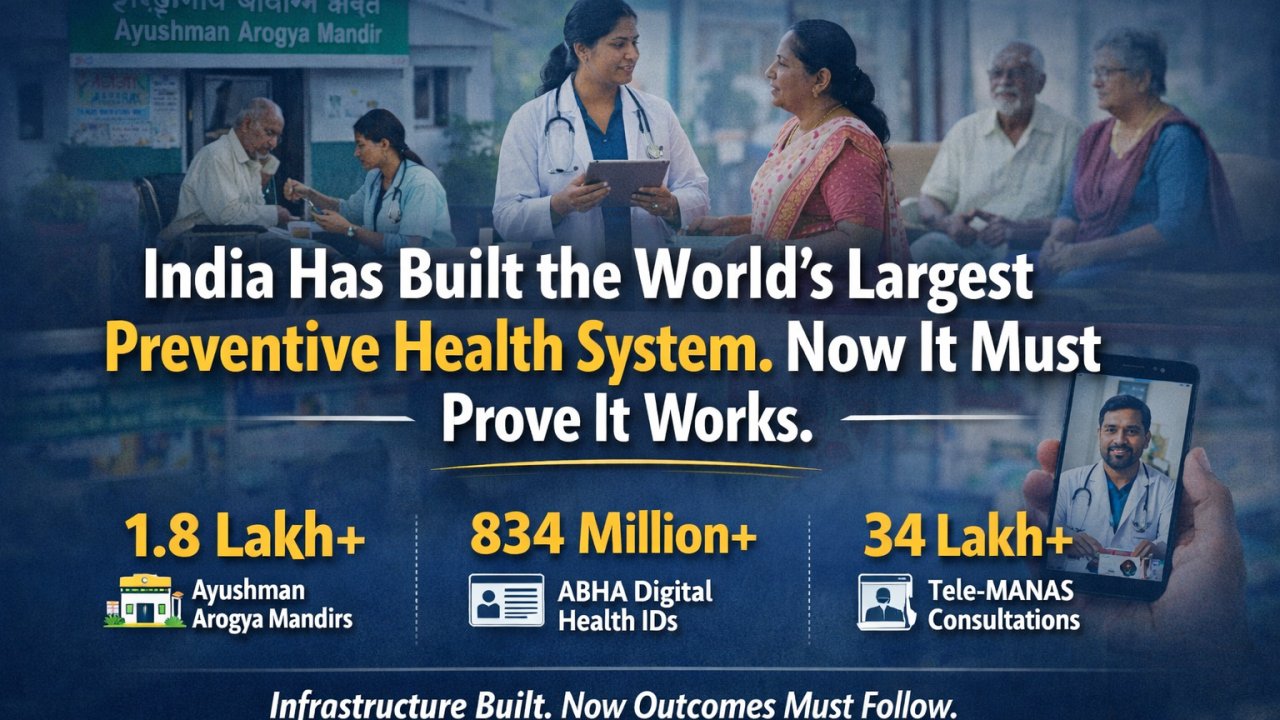
Non-communicable diseases now drive 57% of deaths. Life expectancy has crossed 70 years, accelerating ageing pressures. Healthcare demand is outpacing infrastructure growth. India's response has been massive: 1.8 lakh+ Ayushman Arogya Mandirs, 834M+ digital health IDs (ABHA), 42 crore+ citizens under public insurance, and 34 lakh+ mental health consultations via Tele-MANAS.
The execution gap is where the opportunity lives
Digital health is scaling at a pace most enterprise leaders haven't priced in. The Ayushman Bharat Digital Mission has linked over 787 million digital health records across 438,000 facilities and 738,000 health professionals. Apollo Hospitals delivered 1.2 million tele-consultations in 2024 alone, and its 20 deployed AI tools cut discharge times by 39% while lifting throughput by 7.4%. These aren't pilot metrics. They're system-level numbers signalling a tipping point for health-tech adoption.
Tier-2 and Tier-3 cities now contribute 32% of annual corporate health-check volumes. Preventive care is no longer a metro phenomenon, and enterprise health strategies need to reflect that geography.
The corporate reality: growth at the top, gaps at the bottom
India Inc. is moving fast, but unevenly: 48% growth in preventive health check-ups, a 2.5x increase in consultations, 132% growth in Gen Z engagement, and mental wellness now standard in 10.5% of firms. But 80%+ of factory and shop-floor workers are invisible in health data, and remote workers show minimal follow-up engagement. If enterprises fail to extend preventive care to blue-collar workers, they aren't saving costs, they're embedding future productivity loss into their system.
The gaps that will decide India's prevention outcome
Not all gaps carry equal weight. Three will determine whether India's prevention ambition becomes measurable population health, or remains a well-funded input story.
Screening-to-treatment conversion
India has built world-class screening infrastructure. What it hasn't built at scale is the follow-up pathway. Detected hypertension, diabetes and cancer cases are counted at AAMs, but treatment initiation rates, medication adherence and disease control outcomes aren't publicly tracked. A detection without a treatment pathway isn't prevention. It's a missed opportunity with a data trail.
Women's health and immunisation last mile
Breast cancer screening rates remain suboptimal. HPV vaccination uptake is weak despite availability. Five states (Bihar, Madhya Pradesh, Maharashtra, Rajasthan, Uttar Pradesh) account for 63% of India's remaining zero-dose children. These aren't awareness failures, the awareness infrastructure exists. What's failing is last-mile execution: cold chain reliability, frontline worker capacity and sustained community outreach.
Elderly care and mental health integration
India's elderly population is projected to reach 230 million by 2036. Flu and pneumonia vaccination among this cohort is critically low. Tele-MANAS is scaling, handling 34 lakh calls across 36 states, but mental health integration into primary care remains uneven. Demand for geriatric and mental health services is already outpacing supply.
Where the real opportunity lies
India has crossed the infrastructure phase. The rails are built. The opportunity now is value creation on top of them. Five moves will separate leaders from laggards over the next three years.
Interoperability is the new moat
ABDM integration is no longer optional. Platforms that integrate once and connect with all providers compound network effects faster than those building parallel rails.
AI in primary care is the next margin lever
AI-enabled diagnostics at the AAM level is an underserved adjacency. Apollo's tertiary results are proof of concept; the real scale is at 1.8 lakh primary care centers.
Blue-collar wellness is the biggest untapped market
The formal enterprise wellness market is maturing. The shop-floor, contract and gig workforce is invisible in every current dataset. Whoever cracks engagement here wins large enterprise contracts.
GCCs as digital health demand engines
India's GCC ecosystem is an underutilized channel for life sciences and health-tech pilots. Positioning GCC capability as a preventive health R&D base is an emerging commercial thesis.
AYUSH and medical tourism: an underpriced opportunity
The 2026 budget formalized AYUSH integration into regional medical hubs. Combined with India's cost advantage in elective procedures, this is a policy-backed medical tourism thesis global investors haven't fully priced in.
Every major programme measures inputs, not outcomes. Until India publishes mortality reduction, disease progression and cost-avoidance data tied directly to these interventions, the scale of impact remains an informed estimate, not a verified result.
India has built the world's largest preventive health infrastructure. The next phase is not about building more. It is about making it work.
That means turning 834 million digital IDs into actionable population health intelligence, closing the blue-collar health gap before it becomes a productivity crisis, embedding AI into primary care at the AAM level (not just tertiary hospitals), and ensuring prevention is continuous and outcome-linked, not episodic and input-counted. The winners won't be those who understand the system. They'll be the ones who build value on top of it.